
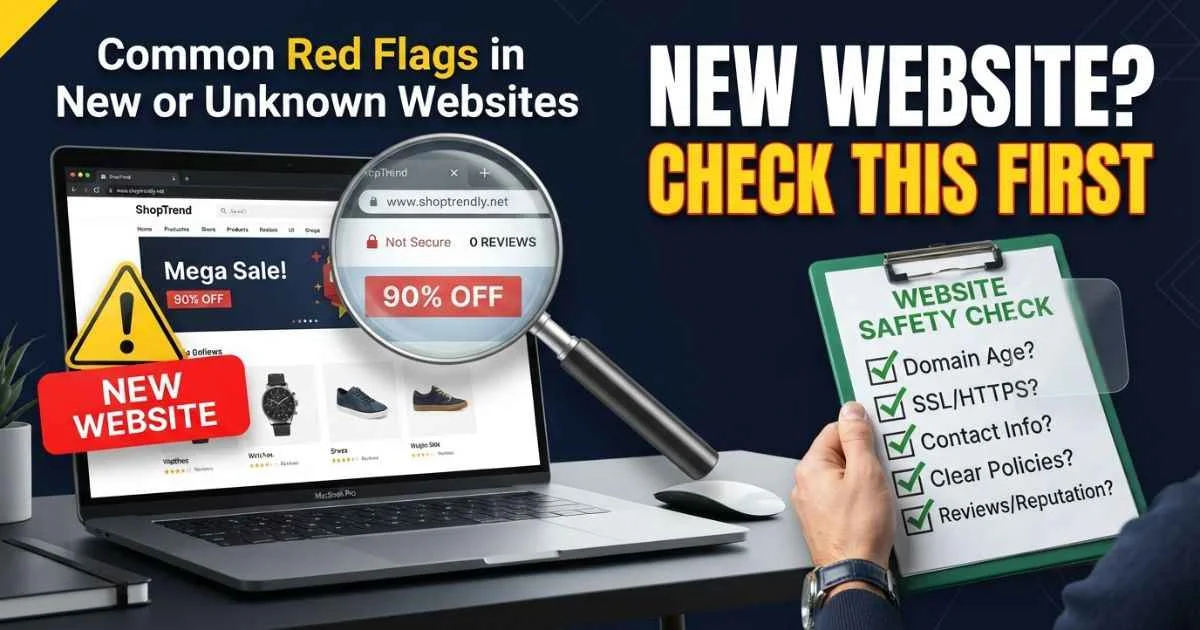
A brand-new website is the hardest kind to judge. It has no review history, no track record, and often no other site mentioning it at all. This guide covers the common red flags in new or unknown websites specifically, including two patterns that catch even careful shoppers off guard: stores built entirely around a single social media ad, and dropshipping sites dressed up to look like established brands.
Most general safety advice assumes a site has some history to check. A site that launched last week doesn’t. That’s the gap this guide fills.
Why new websites are harder to judge
The checks that work well on older sites, like independent reviews, domain age, and search-engine history, often return little or nothing for a brand-new site. That’s not proof of a scam, but it does mean you need a different set of signals to fill the gap.
Some checks that matter for any website, like confirming HTTPS or reading independent reviews, still apply here too. Our full website trust guide walks through each one in detail. What’s different with a brand-new site is how much weight you can place on each check, since it hasn’t had time yet to build the usual signals of trust.
The “no reviews yet” problem
A site with zero reviews isn’t automatically a scam. New businesses start with no reviews by definition. The problem is that scam sites also start with zero reviews, so this single fact can’t tell you which one you’re looking at.
Instead of treating “no reviews” as a red flag on its own, look at what surrounds it:
- Is the site asking for money before it has any track record at all?
A new blog with no reviews is low risk. A new store asking for full payment upfront with no reviews carries more risk. - Is there any independent mention of the business anywhere?
Search the exact business name plus words like “review” or “experience.” Even a single forum post or social comment is more evidence than the site itself provides. - Does the seller acknowledge being new?
A transparent “just launched” message is a small positive sign. A site that implies years of history it doesn’t have is a bigger concern.
A site’s own claim that it has “thousands of happy customers” means little if you can’t find any of them anywhere else.
Red flags specific to new dropshipping stores
Dropshipping is a business model where a store sells a product without holding any stock itself. When you order, the store forwards your order to a separate supplier, who ships the item directly to you, often from overseas. Many dropshipping stores are run honestly. But the model also makes it easy to launch a convincing-looking store in a single day, which is why certain patterns show up again and again in the less honest ones.
Watch for these signs:
- The store sells one hero product, often with a dramatic “as seen on TV” style name, and little else that relates to it.
- Product photos look professionally shot but show up, word for word or image for image, on other unrelated store names too.
- Shipping information is vague about where the item actually ships from, or buried below the checkout button.
- The listed shipping time doesn’t match reality. A 3 to 6 week delivery window is common for dropshipping but is rarely stated clearly upfront.
- The brand name feels generic or randomly generated, with no matching social presence beyond the ads promoting it.
A simple check that works well here: save the main product photo, then run a reverse image search on it. If the exact same photo appears on several other store names selling the same item at different prices, you’re likely looking at a dropshipping listing rather than an original brand.
Sudden social-media-ad-driven stores
Some of the newest and hardest-to-judge stores exist almost entirely inside a social media ad. You never find them by searching. You only see them because an ad found you.
This pattern has a few consistent tells:
| Signal | What it usually means |
|---|---|
| You can’t find the store by searching its name directly | The store has little to no presence outside paid ads |
| Comments on the ad are turned off, or only show praise | Negative comments may have been hidden or deleted |
| The ad account also promotes several unrelated products | The account may be a general ad-buying operation, not a single brand |
| The ad uses heavy urgency language (“selling out,” “today only”) | Urgency is used to reduce the time you spend checking the store |
| The checkout page uses a different business name than the ad | The charge may not clearly match what you thought you bought |
Most major ad platforms now offer a public ad library where you can see how long an ad has been running and how many versions of it exist. Checking this before you click “buy” takes under a minute and can reveal whether you’re looking at an established seller or a freshly spun-up ad campaign.
Fresh signals to check when a site has no track record
Beyond the usual checks, these signals are especially useful for sites too new to have built any history yet:
- Reverse image search the main product or team photos. Stock photos and stolen photos both turn up quickly this way.
- Check the ad library for the business, if you found the site through an ad, to see how long it’s been running and whether the same ad account promotes unrelated products.
- Search for the exact business name in quotation marks, not just the product category, to see if anyone else has mentioned it anywhere.
- Look at whether the checkout page name matches the store name. A mismatch isn’t automatically a problem, but it’s worth noting before you pay.
- Notice whether the site pressures you to decide fast. Legitimate new businesses rarely need you to buy within minutes of arriving.
For the broader signs that apply to any website, not just new ones, the universal checklist of signs a website is safe to use covers the core checks in a quick, scannable format.
A quick decision guide for zero-history sites
When a site has no reviews, no search history, and no domain age to lean on, judge it on what it does have: transparency, realistic claims, and how it behaves when you dig a little deeper.
| If the site… | Then… |
|---|---|
| Is transparent about being new and has verifiable contact details | Proceed with normal caution, same as any first-time purchase |
| Has no reviews and pressures you to buy immediately | Treat as higher risk, wait or verify further before paying |
| Only exists inside a single ad, with no independent mentions anywhere | Treat as higher risk, especially for anything beyond a small purchase |
| Shows product photos that reverse-search to several other unrelated stores | Treat as a strong dropshipping signal, verify pricing and shipping claims carefully |
FAQs about red flags in new or unknown websites
Is a brand-new website automatically a scam?
No. Every legitimate business had a first day with zero history and zero reviews. A new site only becomes higher risk when it also pressures you to pay quickly or can’t be found anywhere outside its own ads.
How can I check a dropshipping store before buying?
Reverse image search the main product photo to see if it appears on other stores, look for specific shipping timelines, and search the business name to see if anyone outside the site has mentioned it.
Why does a store only show up through ads and not in search?
This usually means the store hasn’t built any independent presence yet, whether that’s reviews, press mentions, or organic search visibility. It isn’t proof of a scam, but it does mean you’re relying almost entirely on the ad itself.
Is it normal for a new online store to have zero reviews?
Yes. Every store starts with zero reviews. What matters more is whether the store is transparent about being new, rather than the absence of reviews by itself.
How do I check how long an ad has been running?
Most major social platforms now provide a public ad library or transparency tool where you can search a business name and see its currently running ads and how long they’ve been active.
Should I avoid all new online stores?
No. New stores are a normal part of how businesses grow. Use the signals in this guide, especially urgency pressure and unverifiable claims, to judge risk rather than avoiding every new site by default.
Your next step
Before buying from a store you’ve never heard of, reverse image search its main product photo. It takes under a minute and is one of the fastest ways to catch a dropshipping listing dressed up as an original brand.
This guide helps you assess risk in websites with little or no track record. It cannot guarantee complete safety. When in doubt, verify independently before entering payment or personal information.

Victor Rennard is a multi-niche writer for BaddieHubMagazine.com, creating clear and engaging articles across lifestyle, trends, tech, entertainment, and general guides. With a simple, helpful writing style, Victor aims to give readers quick insights and reliable information on topics that matter.


